In 79 AD Mount Vesuvius buried a Roman villa at Herculaneum, along with its whole library. About 1,800 papyrus scrolls came out of the ground in the 1750s as lumps of charcoal. Hundreds were never opened, because unrolling them would turn them to dust. Over the last few years the Vesuvius Challenge has been reading them without opening them, using X-ray scans and machine learning, and it publishes almost all of its data for anyone to use.
So I went through that open data myself, looking for letters on scrolls that have no published reading yet. I made a two-minute narrated video of the search, and a page where you can spin the real scanned layers in 3D and check every find yourself.
The interactive page, with the 3D viewer and every raw image:
nicedreamzapp.github.io/herculaneum-search
How a burned scroll gets read
It happens in three steps. First a synchrotron, a particle accelerator that makes extremely bright X-rays, scans the rolled scroll and builds a 3D map of everything inside it. Then software and volunteers follow one layer of papyrus through that map and flatten it out, which they call tracing. Last, machine learning models trained on known letters mark where the ink sits on each flattened layer. The ink is carbon on carbonized papyrus, so the eye can barely see it in the raw scan, but the models can.
The software side of my search
I started by downloading every published ink map preview from the Vesuvius Challenge open data bucket. That came to 682 images across 13 scrolls. Many layers had been run through more than one ink model, so for each traced layer I kept the sharpest map, which left 309 layers to look at.
Looking at 309 noisy images by eye is slow, so I had AI agents do the first pass. Each one looked at a small batch of layers and scored them for anything that looked like readable letters. Small batches mattered. When one agent got too many images at once, it started writing scores for images it never actually saw, so I threw that batch out and redid it in smaller pieces.
Then I checked every high-scoring layer myself, and this is the part I care about most. Ink maps are noisy, and your brain wants to see words. So for every candidate I pulled up the same layer as read by every other ink model that had been run on it. The models were trained separately, so if two or three of them show the same letters in the same spot, that is much harder to explain away as noise. A letter only stayed in if more than one model showed it. The one find seen by a single model is labeled weak.
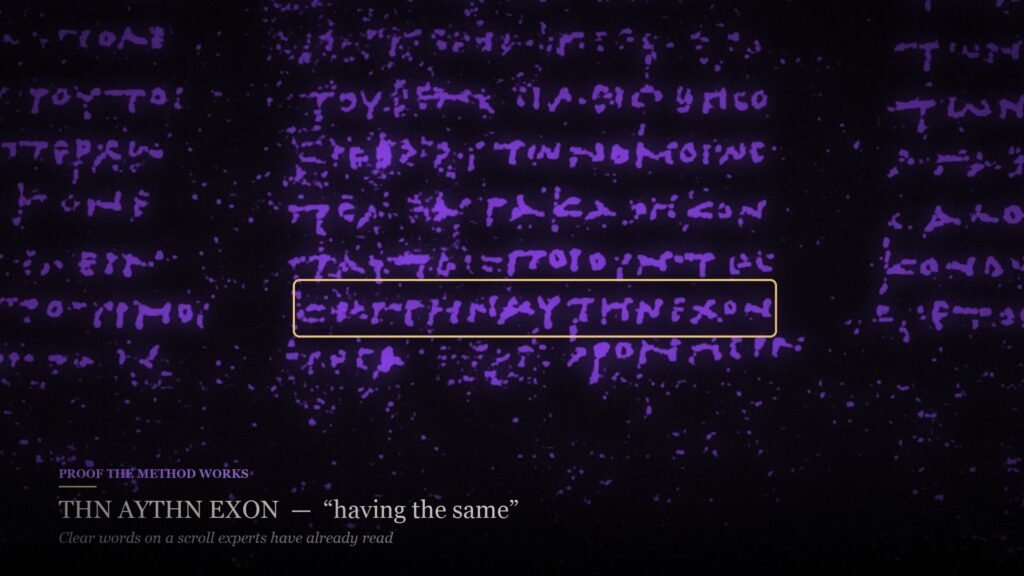
To make sure the method wasn’t fooling me, I ran it on PHerc. 1667 first, a scroll experts have already read. Its ink maps show clean columns of Greek, and one line reads ΤΗΝ ΑΥΤΗΝ ΕΧΟΝ, “having the same.”
What turned up
I found candidate letters on four pieces that have no published reading. PHerc. 9B is the strongest, with all three models agreeing. PHerc. 343 is medium, with two models agreeing. PHerc. 841 shows something like ΚΑ, maybe ΚΑΙ, the Greek word for “and.” PHerc. 500P2 is weak, seen by only one model.
These are candidate letters, not translations. Only trained papyrologists can confirm a reading, which is why every raw image is on the page, unedited except for the purple color. If you work on these scrolls and see something different, I would love to hear it.
Building the video and the page
The 3D shots are the real traced surfaces from the CT scans, rendered in Blender with the ink maps laid on as texture. I rendered them on my own Mac, not a cloud service. The 3D viewer on the page uses the same surfaces in three.js, so you can rotate a layer, zoom in, and slide it from rolled to flat. The narration is my own voice. The soft music underneath was made on my own computer with an open music model. A few shots of the villa and the eruption are AI illustrations, and each one is labeled that way on screen so nobody mistakes it for scan data. Everything was put together with a Python script and ffmpeg.
The whole thing runs on open data and mostly open tools. A few years ago this kind of search took a research lab. Now one person can do it from home, and then show every step so others can check it.
Credits
Scans, traced layers and ink models come from the Vesuvius Challenge open data, used under CC BY-NC 4.0. The scans were made at the ESRF synchrotron in Grenoble and partner facilities, and the ink models were built by the Vesuvius Challenge community. I am not affiliated with the Vesuvius Challenge. The search, 3D renders, video and page are my own work.