This article describes a recent federal court ruling and what it implies for confidential AI use. It is not legal advice. Talk to your bar counsel before changing any firm policy.
📜What the ruling actually says, and what it does not
Heppner is about a client — not a lawyer — who used a public AI tool on his own, after indictment, and then handed the output to his lawyers. The court held that the client’s own act of transmitting prompts to a public platform destroyed any expectation of confidentiality. Receiving the output later did not cure that.
It is not a blanket holding that all AI-assisted legal work loses privilege. The same month, in Warner v. Gilbarco, Inc., No. 2:24-cv-12333 (E.D. Mich. Feb. 10, 2026), a federal court denied a motion to compel disclosure of AI-assisted internal analysis and drafting, holding that the work-product doctrine still applied.
The split is not about whether AI is allowed in legal work. It is about where the AI runs and who sees the data along the way.
Used by a client or counsel. Heppner-style transmission risk to privilege. The contract may help but does not physically prevent transmission.
Used by the firm for its own work-product, where data never leaves the firm. Warner-style work-product protection still applies.
🔀The two real categories of “private AI” in 2026
Spellbook, Harvey, CoCounsel. Pitch: we do not train on your data, contract says so, here is the DPA. Heppner weakens the simple version of the argument; the contract still has to survive scrutiny.
The language model runs on a Mac or PC inside the firm. Outbound network traffic blocked at the firewall. The data is not transmitted because there is no transmission. Verified with lsof -i.
Both categories have legitimate use cases. They are not the same product. After Heppner and Warner read together, they are not the same risk profile either.
🔒Why physical beats contractual for genuinely privileged work
A contract is a promise that something will not happen. A network configuration is a constraint that prevents something from happening.
When Judge Rakoff examined the public AI platform’s terms in Heppner, he was assessing a promise. When you point bar counsel at a Mac running locally with the Wi-Fi physically off and lsof on screen, you are showing them an absence of transmission. That is a different evidentiary category. It is also a verifiable one. Any partner, paralegal, IT vendor, or auditor in the firm can run lsof -i themselves and see whether a network connection is open. The check takes three seconds. It does not depend on trusting a third party’s audit.
⚖️What on-device AI is good at, and what it is not
- NDA and contract review against template clauses
- Document summarization
- Drafting against your own document library, with citation-checking against your corpus
- Daily briefings on what changed in matter folders overnight
- Plain-English Q&A over a firm’s own document set
- Real-time legal research against current case law (the model knows what it was trained on; it does not search Westlaw)
- Tasks that genuinely require frontier cloud-model capability (on-device frontier is roughly a 70B model in 2026)
- Workflows where current online context is the whole point
A realistic implementation uses both: on-device for the privileged work, cloud-with-care (with a DPA, with a written firm policy) for the public research.
🗓️What a small firm can actually do this week
- Write down which matters have had documents touched by public AI tools. You may need this if discovery ever comes for the AI-generated work product.
- Update your firm’s AI policy to differentiate between research (cloud OK with care) and privileged document work (on-device, or contractual ZDR with eyes wide open about Heppner-style risk).
- Pilot on-device for the small, repeatable, privileged tasks first: NDA review, contract summary, intake document analysis, daily briefings.
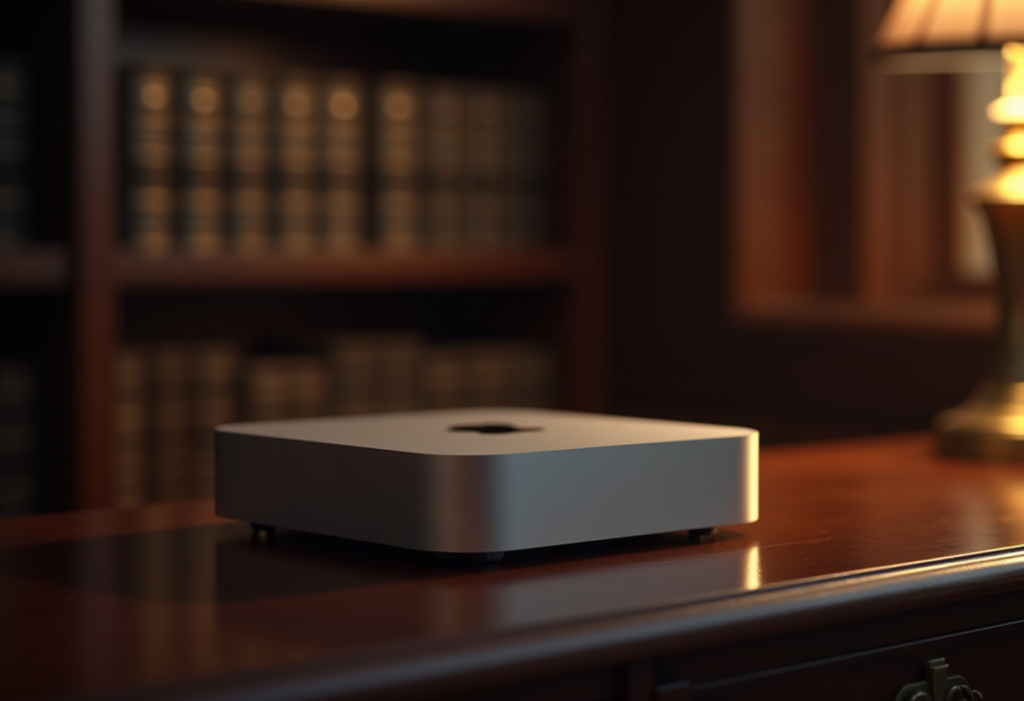
The hardware to run on-device AI privately in 2026 is a Mac mini or MacBook Pro with Apple Silicon. The open-source software stack to run a 31-billion-parameter language model on either is freely available. The total setup time for a technical person is a weekend. The total setup time for a $400-an-hour attorney is also a weekend they will never take.
✍️On that note
I run a small business in Arcata, California, and this exact stack runs it every day. I used to sell a pre-configured version of it, the AirGap Box. I have since retired that as a product. The whole stack is open source, and a competent IT person can stand it up from my repos in a weekend without ever talking to me. That is the point of open source, and honestly it is a better answer for a compliance-minded firm than buying a box from any vendor, me included.
What I offer now is simpler: if your firm wants a system like this built and your team trained on it, email me and we will talk about whether it makes sense. Here is what a full build looks like.
You can watch a live lsof-on-screen demo of an NDA being reviewed on a laptop with Wi-Fi physically off, on YouTube, before deciding anything.
If you are a partner, a managing attorney, or an IT lead at a firm trying to figure out what Heppner and Warner mean for your firm’s AI policy, my email is info@nicedreamzwholesale.com. No sales pitch. I will tell you honestly whether on-device makes sense for your firm before I would let you buy anything from me.
— Matt Macosko
Nice Dreamz LLC
Arcata, California
Sources for the cases discussed:
- K&L Gates, “Litigation Minute: Generative AI Data, Attorney-Client Privilege, and the Work-Product Doctrine” (Feb. 23, 2026)
- Wealth Management, “Attorney-Client Privilege Waived by Client’s Use of Public AI” (2026)
- United States v. Heppner, No. 25-cr-00503-JSR (S.D.N.Y. Feb. 17, 2026)
- Warner v. Gilbarco, Inc., No. 2:24-cv-12333 (E.D. Mich. Feb. 10, 2026)