
💻The question I could not shake
I do all of my AI work on a MacBook Pro with an M5 Max and 128 GB of memory. Songs, videos, vision models for a phone app, a coding agent that runs a 120 billion parameter model with the wifi off. At two in the morning it hit me that I could not name a single PC laptop that could do the same job, and that felt wrong. The PC world has more companies, more money and more engineers than Apple. So I went and looked. This is what I found, why it is this way, and when it is actually going to change.
📏It comes down to one number
Running a language model on your own machine is mostly a memory problem. First the whole model has to fit. A 70 billion parameter model at four bits is about 40 GB. The big open models I like to run, the 120 billion parameter ones, are 60 to 70 GB. Then, for every single word the model writes, the GPU has to read all of those weights once. So the speed you feel is set by how fast the chip can read its own memory. People call it memory bandwidth and it is measured in gigabytes per second.
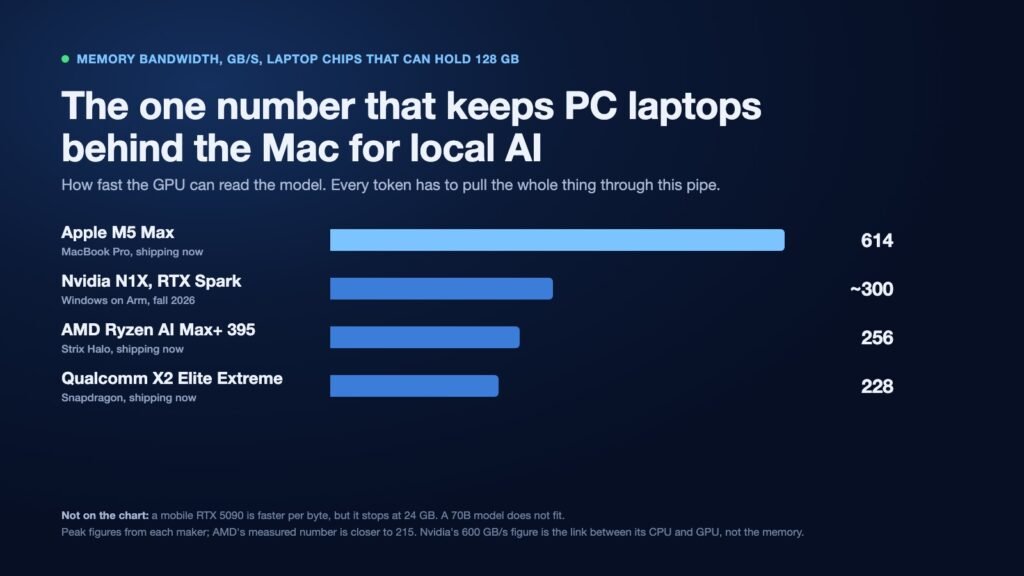
The M5 Max reads memory at 614 GB/s and the GPU can use nearly all of the 128 GB. On this machine a 120 billion parameter model at eight bits writes close to 90 words a second, a dense 70 billion model at four bits lands in the mid teens, and a 27 billion model is fast enough that you stop noticing it. That is the whole trick. A big fast pool of memory that the GPU owns outright.
🧩Why the PC laptop can’t just copy it
A traditional PC laptop is two computers taped together. The CPU has its memory sticks, and the graphics chip has its own separate memory soldered next to it, the VRAM. The GPU can only run a model that fits in the VRAM, and the biggest mobile GPU you can buy, the RTX 5090 laptop chip, tops out at 24 GB. It is a monster per byte, faster than my Mac at the same model size, but a 70 billion parameter model simply does not fit. You can spill the overflow to system memory and the speed falls off a cliff.
Apple got out of that trap in 2021. The M1 Max put the memory chips right on the processor package, wired them to a 512 bit bus, and let the CPU and GPU share one pool. That first chip already did 400 GB/s, five years ago. Since then it has just kept climbing, 546 on the M4 Max, 614 on the M5 Max. Apple could do it because Apple designs the chip, the memory package, the operating system and the machine, and answers to nobody in that chain.
The PC side has three different problems at once. The memory standard is built around swappable sticks, which are slower and further from the chip than memory soldered on the package. Nvidia sells its GPUs in tiers by VRAM, so a laptop with 128 GB of graphics memory would eat its own workstation business. And Windows still thinks of graphics memory and system memory as two separate things, so even when a PC chip does share memory, the operating system caps how much the GPU can take.
🔴AMD already tried, and it is a real machine
The closest thing to my laptop on the PC side is AMD’s Ryzen AI Max+ 395, the chip people call Strix Halo. It does the Apple thing. One pool of memory, up to 128 GB, shared between the CPU and a big integrated GPU. You can buy it in the HP ZBook Ultra and the Asus ROG Flow Z13 and a pile of mini PCs, and the mini PCs cost a third of what a Mac Studio does.
The catch is the pipe. Strix Halo has a 256 bit bus and peaks at 256 GB/s, with real world measurements closer to 215. That is a bit more than a third of the M5 Max, and people who have put them side by side see the Mac generating two to two and a half times as many words a second. On top of that, Windows only lets the GPU claim 96 of the 128 GB. To get the whole pool you run Linux and keep a spreadsheet of which driver stack is faster for which model this month, because it flips back and forth between ROCm and Vulkan. It works, and I respect it, but it is a hobby, not a laptop you open and go.
🟢Qualcomm and Intel: close on paper, not in practice
Qualcomm’s Snapdragon X2 Elite Extreme started shipping in laptops in April. It has memory on the package like Apple, up to 128 GB of it, and the GPU actually edges out the plain M5 in graphics benchmarks. But the bus is 192 bits wide and tops out at 228 GB/s, so for big models it lands right next to AMD. It is a very good laptop chip that happens to have a lot of memory, not a machine built to chew through a 70 billion parameter model.
Intel’s Panther Lake showed a 70 billion parameter model running on a reference laptop at CES this year, which was a nice demo. But the memory is not on the package and the bus is still 128 bits wide, which works out to about 154 GB/s with the fastest memory Intel supports, a quarter of the Mac. Intel is a generation behind the other two on this specific problem and two behind Apple.
🟩The one that could actually change it: Nvidia’s laptop chip
This is the story to watch. Nvidia and MediaTek built an Arm laptop chip called the N1X, and Nvidia is shipping it as RTX Spark this fall, October by most reports. The top version pairs a 20 core CPU with a 6,144 core Blackwell GPU and up to 128 GB of unified memory on a single chip. Windows on Arm, and it is going into machines from Asus, Dell, HP, Lenovo, MSI and Microsoft’s own Surface line. Nvidia says it will run models up to 120 billion parameters on the device.
Here is the honest read on the bandwidth. The 600 GB/s number that keeps getting quoted is the link between the CPU half and the GPU half of the chip. The actual memory feeding the GPU is LPDDR5X at roughly 300 GB/s, about half of my Mac. So on raw speed it slots in above AMD and below Apple, not on top of it.
What makes it dangerous anyway is one word: CUDA. Every AI tool on earth was written for Nvidia first. On my Mac I lean on MLX and the people who port things to Metal, and I have personally had to write the missing pieces more than once to get a new model running. On an RTX Spark laptop the thing just runs, the day it comes out, with the same code the labs used. Half the bandwidth with all of the software might be a better deal for a lot of people than the reverse. The early reporting says these laptops start around $2,900, so Nvidia is pricing it against exactly the machine I am typing on.
📅When the pipe itself catches up
The bandwidth gap closes when the memory standard changes. AMD’s next big chip, Medusa Halo, is expected to be the first to use LPDDR6. Same 256 bit bus as today, but the leaks put it between 512 and 691 GB/s, which is anywhere from just under my M5 Max to a little above it, with up to 24 Zen 6 cores and a much bigger GPU. The timing is the fuzzy part. The optimistic reports say late 2026, the careful ones say 2027, and the laptop version is rumored to be a smaller cut of the chip with a narrower bus. My bet is a real Medusa Halo laptop in 2027, and by then Apple will have shipped the M6.
So here is my timeline. Right now, September 2026, nothing in a backpack matches this laptop for local AI, and it is not close. In October, Nvidia shows up with half the bandwidth and all of the software, and for the first time there is a PC laptop I would actually tell someone to consider for this work. Sometime in 2027 AMD ships a chip with a pipe as wide as Apple’s, and Windows finally has to figure out how to hand a GPU 120 GB of memory without a Linux detour. That is when the argument gets interesting.
🧭What I actually think
Apple is not ahead because of magic. Apple is ahead because five years ago it made one unpopular decision, soldering the memory to the chip so tightly that you can never upgrade it, and that decision happened to be exactly the right one for a kind of computing that did not exist yet. The PC industry is built to let a hundred companies mix and match parts, and that is a real strength almost everywhere except here, where the winning design is one company owning the whole stack.
I am not going anywhere. I run bf16 weights whenever they fit and this is still the only laptop that lets me do that at this size. But I will be first in line to test an RTX Spark machine when it lands, and if Medusa Halo shows up with the numbers in the leaks, I will run the same models on both and post what happens. That is the kind of week I love.